Five Dollars at the Door: What NYC's Cover Charges Actually Say About Who Owns the Night
Five Dollars at the Door: What NYC's Cover Charges Actually Say About Who Owns the Night
There's a moment that happens outside almost every New York City venue worth talking about. You're standing on the sidewalk, maybe in a coat that's either too heavy or not heavy enough, and someone — a clipboard, a velvet rope, a hand-written sign taped to a door — tells you what it costs to be inside. That number, whatever it is, feels transactional. It isn't.
Cover charges are the city's most under-examined social text. They are identity architecture dressed up as revenue strategy. And if you start reading them like anthropology instead of accounting, New York starts to look like a very different place.
The $5 Door and What It's Protecting
Take a Thursday night at one of Harlem's surviving jazz rooms — the kind of spot that's been on the same block since before the neighborhood's most recent round of reinvention. Five dollars. Maybe eight. Cash only, often as not. The bartender knows half the room by name. The musicians on stage have been playing together longer than some of the newer Harlem residents have been alive.
That low cover isn't a pricing accident or a failure of ambition. It's a deliberate signal: this room is for the people who live here. It's a soft but firm resistance to the kind of cultural tourism that prices out the very communities who built the culture being consumed. The $5 door is a political act wearing the costume of a bargain.
Harlem's jazz economy has always had to balance preservation against visibility. Too exclusive and you starve. Too open and you become a museum of yourself, packed with visitors who want the vibe without the history. The low cover is a calibration tool — keeping the room affordable enough that longtime residents can still walk in on a whim, while the music itself does the filtering. If you don't know what you're hearing, you'll probably leave before the second set anyway.
The $40 Techno Tax and the Gentrification Premium
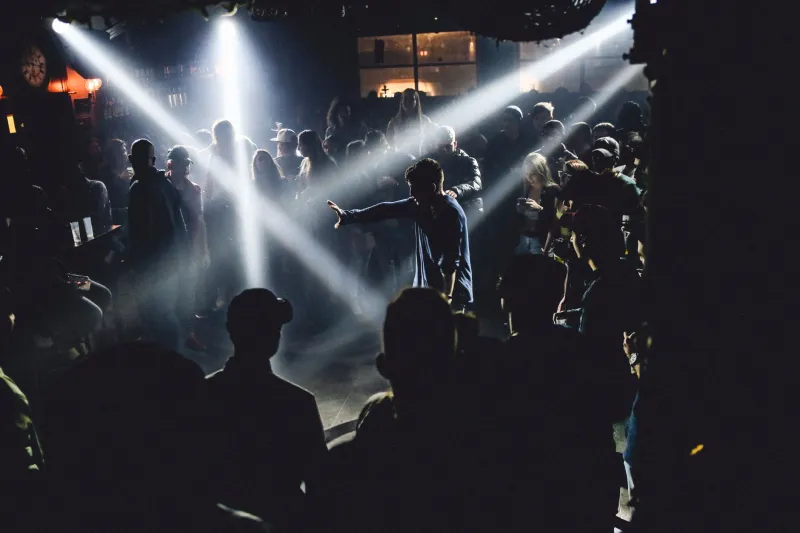
Now travel to Bushwick on a Saturday night. The venue is a former factory, the ceiling is 30 feet up, and the headliner flew in from Berlin. The cover is $40 in advance — more at the door, if the door is even an option by 1 a.m.
Here's the thing about a $40 cover: it's not paying for the DJ. It's paying for the idea of the room. The industrial aesthetic, the carefully curated darkness, the sense that you've earned access to something underground even though it's been written up in three different lifestyle publications this month. The price creates the perception of scarcity, and scarcity creates desirability, and desirability is the only currency that actually matters in this economy.
But there's a harder truth underneath that. A $40 door in Bushwick is a neighborhood that was, not very long ago, home to working-class Puerto Rican and Dominican families who couldn't have imagined paying $40 to stand in a building on their own block. The techno warehouse didn't cause gentrification, but it is one of its most visible and least-interrogated beneficiaries. When the cover charge climbs, so does everything else — the rent, the displacement, the distance between who a neighborhood used to belong to and who it belongs to now.
The $40 cover isn't just a price point. It's a new landlord.
Free Before 11: The Midtown Bait
And then there's the rooftop bar in Midtown with the 'free before 11' policy — which, in practice, means free for the people who can leave work at a normal hour, take a cab uptown, and get there before the line forms. Free, in other words, for a very specific kind of person.
The 'free before 11' model is sophisticated social engineering. It rewards early arrival, which fills the room with a crowd that's already comfortable in Midtown, already dressed the part, already pre-sorted by the invisible filters of professional schedule and disposable income. By the time the cover kicks in at 11, the room's identity is set. The $25 late-entry charge isn't keeping people out so much as it's confirming who was always meant to be there.
This is the cover charge as velvet rope by other means — achieving the same demographic outcome without the optics of a bouncer making judgment calls at the door.
Genre as Gatekeeping
It's worth noting that venue type and music genre do a lot of the heavy lifting that the cover charge only finishes. A reggaeton night in the Bronx with a $10 cover and a Latin trap showcase in Lower Manhattan with a $15 cover are not the same economic proposition — not because of the $5 difference, but because of everything the genre signals about who the room expects to walk through the door.
Genre has always been a proxy for demographics in the nightlife economy, and cover charges are calibrated accordingly. Promoters know their crowd. They know what that crowd will pay, what they expect to find when they get inside, and what the room's vibe costs to maintain. The cover charge is where all of that implicit knowledge becomes explicit — a single number that encodes race, class, neighborhood, and cultural ownership all at once.
Reading the Room Before You're In It
What would it look like to take cover charges seriously as civic data? To map them across the five boroughs and watch the patterns emerge — the way low covers cluster in neighborhoods with strong community roots and high covers trail the path of development dollars? You'd end up with something that looks less like a nightlife guide and more like an economic inequality report with a better playlist.
None of this means the $40 techno night is evil or the $5 jazz room is pure. Venues are businesses, and businesses exist in the city they exist in, shaped by the same forces that shape everything else. But the cover charge is one of the few places where those forces become legible in real time, in the open, on a Saturday night.
Next time you're standing outside somewhere new, about to hand over whatever the door asks for, take a second before you reach for your wallet. Ask yourself what that number is actually saying — about the room, about the neighborhood, about who the night was designed for. The answer is almost never just the price of admission.
It's the whole story, compressed into a single ask.