4 AM and Invisible: The Workers Who Rebuild NYC's Nightlife Before You Wake Up
The last dancer has gone home. The DJ has packed up. The bartenders have counted their tips and disappeared into the pre-dawn dark. The lights — finally, mercifully — are fully on.
And now the real work starts.
Somewhere in the back of almost every club, bar, and live venue in New York City, a crew of workers nobody photographed, nobody bought a drink for, and nobody will name-drop tomorrow is pulling on gloves, unfolding mop handles, and beginning the long process of undoing everything the night created.
They are the ghost shift — and without them, there is no next night.
The Hours Nobody Romanticizes
Nightlife culture has a deep and well-documented love affair with its own mythology. We celebrate the DJ who played until sunrise. We write essays about the last hour on the dance floor. We document the bartenders and the promoters and the door staff. We have entire magazines — entire websites — dedicated to the experience of the night.
But the 4 AM to 8 AM window, the hours when the transformation from wreckage back to venue actually occurs, exists almost entirely outside the cultural narrative.
Carmen has been on cleaning crews at Manhattan clubs and event spaces for nine years. She works a rotation of three venues, typically starting her shift around 3:30 AM and finishing between 7 and 8 depending on the size of the previous night's event.
"People ask me what I do and when I say I clean clubs, they think I'm cleaning during the night, like between customers," she says. "When I explain it's after — when everyone is gone — they get this look. Like they never thought about it. Like the place just... resets itself."
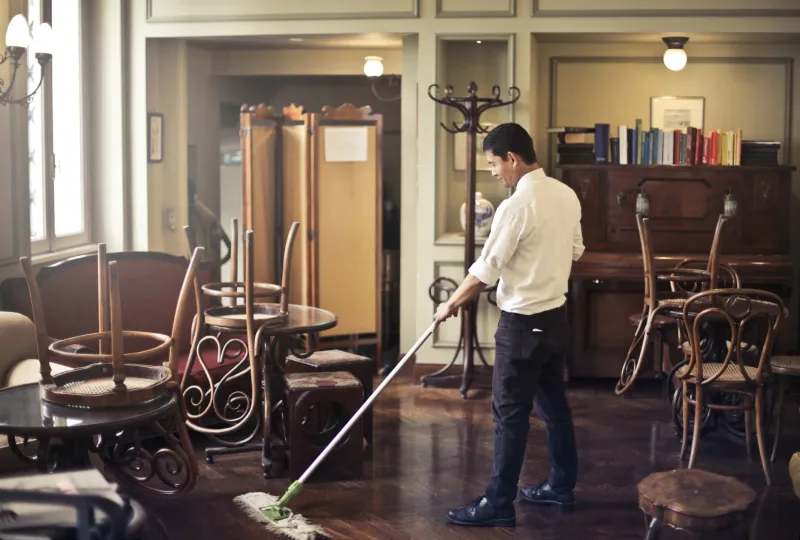
It doesn't reset itself. Carmen and her colleagues reset it. On a heavy weekend night, that means several hundred square feet of sticky floors, overflowing trash receptacles, bathrooms that have absorbed four hours of full-capacity use, bar surfaces coated in spilled drinks and garnish debris, and a general layer of accumulated humanity that has to be addressed before the space can function again.
"I actually like it," she says, and there's no performance in her voice. "It's quiet. The music is off. I have my headphones. I know what I'm doing and I do it. There's something satisfying about watching a room come back."
The Restockers and the Logistics of Tomorrow
While Carmen's crew works the floors and surfaces, another layer of overnight labor is simultaneously managing the logistical reset. Bar restockers — often a separate team from the cleaning crew — are pulling inventory counts, hauling cases from storage, restocking speed rails and back bars, and making sure the opening bartender tomorrow walks into a fully operational setup rather than a depleted one.
Darius has been doing overnight bar restocking at a rotating set of venues in Brooklyn and lower Manhattan for four years. He typically works three to five nights a week, starting between 3 and 4 AM and finishing by 7.
"The job is basically invisible logistics," he says. "I know every bar I work better than most of the bartenders who work there during the day. I know where every bottle goes, how the coolers are organized, what they burn through fastest on a weekend versus a weekday."
He describes a kind of institutional memory that overnight workers develop about venues — an intimate knowledge of how spaces function that the front-of-house staff, who interact with the place only when it's alive and busy, rarely accumulate.
"I know which drain in which bathroom backs up first. I know which section of the bar floor gets slippery first because of how the ice melts. I know which light in the back hallway flickers when it's about to go out." He pauses. "Nobody asks me, but I know."
The Kitchen Crew and the 5 AM Prep
For venues that run late-night food service — and NYC has more of them than most cities — the overnight hours mean a kitchen crew that bridges the gap between the last order of the night and the first prep of the next day.
At one well-known Brooklyn venue that runs food service until 3 AM on weekends, line cook Tomas is often among the last to leave and among the first to return. On busy nights, he finishes his closing duties around 4 AM, goes home for a few hours, and is sometimes back by 9 or 10 AM for prep.
"There's no real separation for me," he says. "The night bleeds into the morning bleeds into the next night. That's just the rhythm."
He talks about the specific exhaustion of nightlife kitchen work — different, he insists, from the exhaustion of a daytime restaurant kitchen. "It's the hours, obviously. But it's also the energy you absorb. When a room is going off and the kitchen is slammed at 1 AM, there's an electricity to it. And then at 3:30 AM when you're scrubbing down the line alone, that electricity is gone and you're just tired in a specific way."
What the City Owes and Rarely Pays
The overnight workforce in NYC nightlife exists at the intersection of multiple vulnerabilities: irregular hours, physically demanding labor, inconsistent scheduling, and a cultural context that has historically treated them as background infrastructure rather than essential contributors.
Many work without the job security or benefits that would be standard in other industries. The venues they service are often operating on thin margins, which means labor costs are perpetually under pressure. And the workers themselves are frequently immigrants, people of color, and members of communities that have been systematically excluded from the very nightlife culture they spend their nights maintaining.
Carmen is direct about the contradiction. "The people who come to these clubs — they're there for a good time. I understand that. I want them to have a good time. But I also think sometimes: do they know I exist? Do they think about who cleaned the bathroom they used at 2 AM? Who made sure the floor was clean enough to dance on?"
She's not bitter about it, or at least she doesn't perform bitterness. But she is clear.
"This city loves its nightlife. It talks about it all the time. But the people who make it possible to have nightlife — the ones who show up at 4 AM — we don't really get to be part of that story."
The Room Remembers
There's a particular quality to a venue in the hour before it opens — after the overnight crew has finished and before the first staff member of the day arrives. The floors are clean. The bars are stocked. The air has been turned over. The chairs are still up on the tables or the stools are still upended on the bar.
The room is quiet and ready and, in its own way, whole.
Somebody made that happen. A lot of somebodies, actually, working through the coldest and darkest hours the city offers, invisible and essential and almost entirely unacknowledged.
The night you had last Saturday? The one you'll be talking about for weeks?
They built the stage for it. They'll build it again tonight.